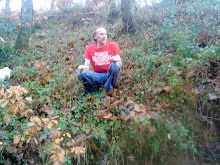
Collecting Trees at New Bridge
Today; I'm here, at New Bridge, which is a small hamlet on the Dart Vally in Devon, on a swamp tree collecting mission.
I suppose this bridge must have been new at some time, but I couldn't think of a more inappropriate name for it. Maybe ancient rickety old bridge, might be better. It is quite amusing watching huge camper vans trying to get over in in the summer.
Here the River Dart cuts into Dartmoor in a deep snaking gorge, which is mostly thick natural forest, that expands every year, as it spreads further onto the moors.
Allot of Canoeists and kayakers use this stretch of river at all times of year, as it is Southern England's fastest flowing large river, it has many small waterfalls and lots of rapids, so it is perfect for that sort of thing, of course; I come here for the plant life, which at this time of the year; means trees.
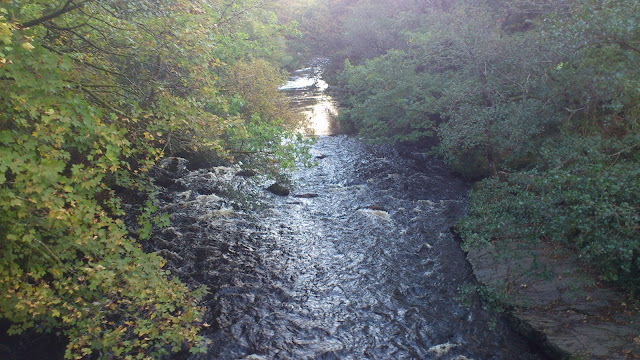 |
| The view upstream from New Bridge |
|
Willows and Birch
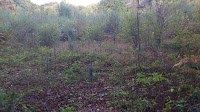
As you can see, from these pictures; there are litterally thousands of baby trees. This little corner of this vast froest, was a conifer plantation untill a few years ago. When they removed the conifers; the whole area seeded with millions of baby trees, mostly Willow and Birch, but with sizable quantities of Oak, Hazel and Alder aswell. There is much thinning out to be done here and a seemingly endless supply of little trees to take away and plant further up stream.
 The reason that so many trees have seeded here, it because, when the land was conifers, there was very little light getting down to the forest floor and therefore little to no vegetation, coupled with the fact that the site is surrounded by forest on three sides. When the conifers were suddenly felled; the bare earth in full sunlight all erupted into tree seedlings, which now, some half a decade later, are just a tangled mass of competing saplings.
Just look how close together the little tree trunks are, to each other, on the caption above.
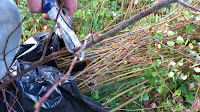
I just cut paths through this thick mass, which allows these trees to grow better and which gives me many trees to take away and plant. To the right, I prune off the excess growth, down to strong healthy buds and stick them all in a plastic sack, to prevent the roots from drying out. Below right; I carefully cut out a root ball around each tree that I take, to give it them highest chance of survival in their new home.
Dog Roses and Hazels
I have enjoyed a great deal of success with Hazels and Dog Roses in my various plantations on Dartmoor. Both are tough enough to withstand the harsh conditions and both thicken up the edges and the underneath of a woodland beautifully. In fact I would consider them an essential ingredient.
Dog rose hips are full of itching powder, which you can put down some one's back and it makes them itch. The hips are there all winter, so they provide food for a wide variety of woodland creatures. They also spread into a tangled thorny mass, which protects little trees from Sheep and other tree or bark munching herbivores, so I like to plant them with the trees I plant, to protect them, also the branches of the small trees, gives support to the Dog Rose, which is a kind of rambling, climbing plant and this raises it's procumbent branches out of the tall summer grass and into the light.
Dog roses spread vegetatively and, like brambles; the trailing branches root and form a new clump, anywhere they touch the ground.


 Digging up a Tree Demonstration

 Allot of Apples always go to waste up here. For years it was in a wild garden, to some barely used chalet type property.
 I picked about fifty nice ones off the tree and threw them down to my accomplice, who preferred not to be mentioned on here (the photographer).
 These trees are going to be planted at night, so I don't want to be holding each individual tree up against the moonlight, to determine the species, so I tend to sort them into bags of type before hand, to make my mission faster and easier. The only kind of light I ever take with me is my mobile phone and a cigarette lighter. I do not possess a torch.
 Often I throw in some wet leaves as well.


 As you can see, from these pictures; there are litterally thousands of baby trees. This little corner of this vast froest, was a conifer plantation untill a few years ago. When they removed the conifers; the whole area seeded with millions of baby trees, mostly Willow and Birch, but with sizable quantities of Oak, Hazel and Alder aswell. There is much thinning out to be done here and a seemingly endless supply of little trees to take away and plant further up stream.
 The reason that so many trees have seeded here, it because, when the land was conifers, there was very little light getting down to the forest floor and therefore little to no vegetation, coupled with the fact that the site is surrounded by forest on three sides. When the conifers were suddenly felled; the bare earth in full sunlight all erupted into tree seedlings, which now, some half a decade later, are just a tangled mass of competing saplings.
 I just cut paths through this thick mass, which allows these trees to grow better and which gives me many trees to take away and plant. To the right, I prune off the excess growth, down to strong healthy buds and stick them all in a plastic sack, to prevent the roots from drying out. Below right; I carefully cut out a root ball around each tree that I take, to give it them highest chance of survival in their new home.